
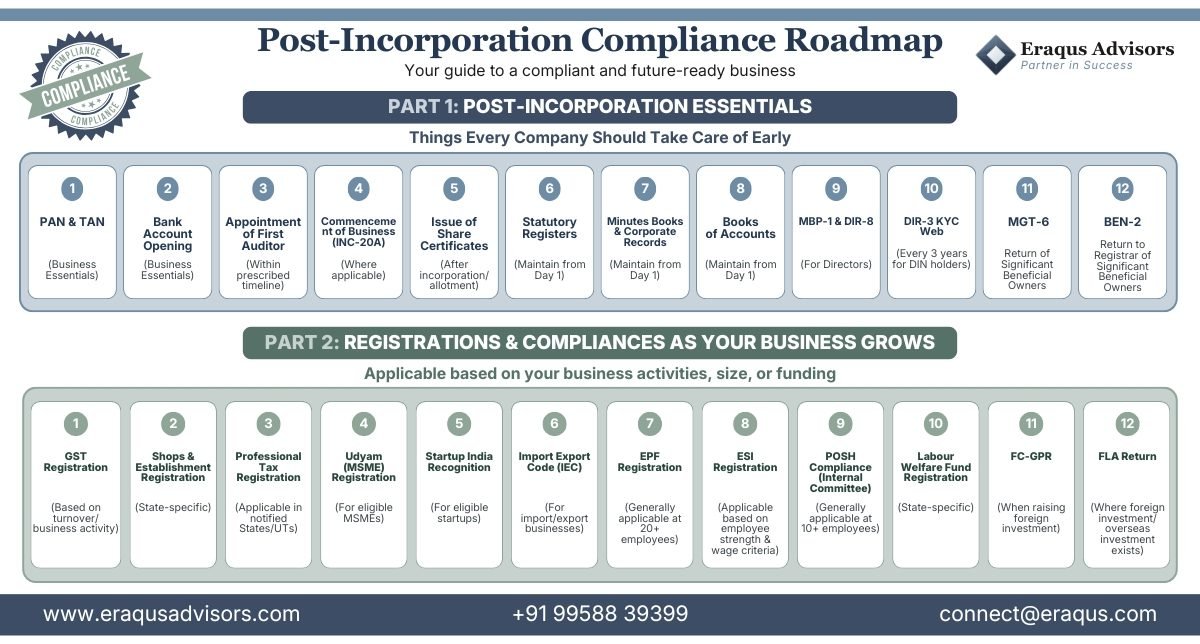
Incorporating a company is day one, not the finish line. What follows, PAN allotment, statutory registers, DIR-3 KYC, GST registration, EPF and ESI, POSH, FC-GPR, is where most founders lose track, and where Registrar of Companies (ROC) and Ministry of Corporate Affairs (MCA) penalties quietly pile up.
2026 has been an unusually active year for Indian corporate compliance, with the MCA overhauling director KYC, changes to FEMA filing practice, and the four Labour Codes moving into force. This roadmap breaks the entire post-incorporation lifecycle into two parts: Day-1 essentials and growth-stage registrations, updated for where the law actually stands today.
Part 1: Post-Incorporation Essentials
What every company must handle early, several of these from Day 1.
1. PAN and TAN
Every company must obtain a Permanent Account Number (PAN) and Tax Deduction Account Number (TAN) immediately after incorporation. Since these are now generated alongside the Certificate of Incorporation through the SPICe+ web form, most companies already have both on Day 1, but they still need to be activated with the bank and payroll systems before the first transaction.
2. Bank Account Opening
A current account in the company's name is a pre-requisite for share capital infusion, vendor payments, and statutory dues. Banks now cross-verify PAN, TAN, and the Certificate of Incorporation directly against the MCA database, so KYC mismatches at this stage are a common cause of delay.
3. Appointment of First Auditor
Under Section 139(6) of the Companies Act, 2013, the first auditor must be appointed within 30 days of incorporation by the Board, or within 90 days by members in an EGM if the Board fails to act.
4. Commencement of Business (Form INC-20A)
Companies with share capital must file Form INC-20A within 180 days from the date of incorporation, confirming that subscribed capital has been received. Until it is filed, the company cannot lawfully commence business or exercise borrowing powers, and default carries a penalty of ₹50,000 on the company along with ₹1,000 per day on every officer in default, subject to a ₹1 lakh cap.
5. Issue of Share Certificates
Share certificates must be issued within 2 months from the date of allotment or incorporation. The certificates must be duly executed, signed, and stamped in accordance with the applicable State Stamp Act or the Indian Stamp Act, 1899, as applicable. Stamp duty is payable on the issue of share certificates, with rates varying from State to State.
This is also the item most affected by 2026 regulatory momentum. MCA's push toward dematerialisation of shares for private companies, under the Companies (Prospectus and Allotment of Securities) Rules, continues to widen through threshold-based extensions. Any company whose paid-up capital could bring it within scope should confirm its current demat obligation before the next allotment round rather than assuming physical certificates remain sufficient.
6. Statutory Registers
Registers of Members, Directors, Charges, and Related Party Transactions must be maintained from Day 1 under Section 88 of the Companies Act, 2013. These are the first documents any ROC inspection or due-diligence exercise will ask for.
7. Minutes Books and Corporate Records
Board Meeting, General Meeting, and Committee Meeting minutes must be properly recorded, entered within 30 days of the meeting, and preserved permanently under Section 118 of the Companies Act, 2013. These records serve as official evidence of the decisions taken by the company and must be maintained in accordance with prescribed rules.
8. Books of Accounts
Section 128 of the Companies Act, 2013 requires accrual-based books of accounts to be maintained at the registered office, or another intimated location, and preserved for at least 8 years.
9. Director Disclosures: MBP-1 and DIR-8
Under Section 184 of the Companies Act, 2013, directors must disclose their interest in other entities through Form MBP-1 at the first Board Meeting of every financial year and whenever there is any change in the disclosed interest. Further, under Section 164, directors must provide Form DIR-8 confirming that they are not disqualified from appointment or continuation as a director.
10. DIR-3 KYC Web: The Big 2026 Change
This is the single biggest compliance change in this roadmap. Through the Companies (Appointment and Qualification of Directors) Amendment Rules, 2025 (G.S.R. 943(E), effective 31 March 2026), MCA has replaced annual DIR-3 KYC filing with a triennial cycle, once every three consecutive financial years. The earlier e-Form DIR-3 KYC and DIR-3 KYC-Web have been merged into a single unified web-based form, and physical and e-Form filing has been discontinued. Three practical points matter more than the headline:
The cycle is not a common date across all directors. It is reckoned by reference to the financial year of DIN allotment, which means the first filing under the new regime falls in different years for different DIN holders. Directors and companies should confirm the applicable cycle for each DIN rather than adopting a single organisation-wide deadline.
The event-based obligation has not relaxed. Any change in personal mobile number, email address, or residential address must be reported by filing DIR-3 KYC Web within 30 days, with applicable fee. This runs on a separate track and does not substitute for, or reset, the routine triennial filing.
Consequences are unchanged. Non-filing continues to result in DIN deactivation, with a ₹5,000 fee for reactivation. A deactivated DIN prevents the director from signing any MCA filing or acting as a director until restored.
11. MGT-6: Declaration of Beneficial Interest in Shares
Under Section 89 of the Companies Act, 2013, companies are required to file Form MGT-6 with the Registrar of Companies where the registered owner and the beneficial owner of shares are different. The form is filed upon receipt of declarations in Forms MGT-4 and MGT-5 and must be submitted within the prescribed timeline. Companies should ensure timely identification, documentation, and reporting of beneficial ownership to maintain compliance with statutory requirements.
12. BEN-2: Return of Significant Beneficial Owners
Under Section 90 of the Companies Act, 2013 read with the Companies (Significant Beneficial Owners) Rules, 2018, companies are required to identify and maintain details of Significant Beneficial Owners (SBOs) who hold beneficial ownership or exercise significant influence or control over the company. Upon receipt of Form BEN-1 from the SBO, the company must file Form BEN-2 with the Registrar of Companies within the prescribed timeline and ensure that any subsequent changes in SBO particulars are duly reported.
Part 2: Registrations and Compliances as Your Business Grows
Applicable based on your business activities, size, or funding.
1. GST Registration
GST registration becomes mandatory when a business crosses the prescribed aggregate turnover threshold under the CGST Act, 2017. Generally, the threshold is ₹40 lakh for suppliers of goods and ₹20 lakh for suppliers of services in eligible States, with lower limits applicable in certain States and for specified categories.
Businesses should note that GST applicability is not determined by turnover alone. Certain supplies, including exports and other notified categories, may require registration irrespective of turnover to claim applicable GST benefits and comply with statutory requirements. Aggregate turnover is calculated on an all-India PAN basis, including taxable supplies, exempt supplies, exports, and inter-State supplies made under the same PAN.
2. Shops and Establishment Registration
A State-specific registration is required for any commercial establishment, governing working hours, holidays, and employment conditions.
3. Professional Tax Registration
Applicable in States that levy professional tax, such as Maharashtra, Karnataka, and West Bengal, with separate registrations for the employer (PTEC) and employees (PTRC).
4. Udyam (MSME) Registration
The classification thresholds revised in the Union Budget 2025-26 remain the operative framework through 2026. Both the investment and turnover conditions must be met:
| Category | Investment up to | Turnover up to |
|---|---|---|
| Micro | ₹2.5 crore | ₹10 crore |
| Small | ₹25 crore | ₹100 crore |
| Medium | ₹125 crore | ₹500 crore |
Registered MSMEs should note Section 43B(h) of the Income-tax Act alongside Section 15 of the MSMED Act, 2006: payments to micro and small suppliers must be made within 45 days from acceptance, or the buyer loses the expense deduction. Any contractual term extending beyond 45 days is void to that extent. Companies with amounts outstanding to MSME suppliers beyond 45 days must also file the half-yearly MSME Form-1.
5. Startup India Recognition
DPIIT Startup Recognition unlocks the tax holiday under Section 80-IAC, angel tax relief, and easier public procurement access for eligible early-stage companies. For the Section 80-IAC income tax holiday, DPIIT recognition is only the first step. Eligible startups must separately satisfy the prescribed conditions and obtain approval from the Inter-Ministerial Board (IMB) for claiming the tax exemption. The Finance Act, 2025 extended the incorporation window for Section 80-IAC eligibility to startups incorporated before 1 April 2030, subject to fulfilment of other conditions.
Startups should also note that Minimum Alternate Tax (MAT) provisions under Section 115JB of the Income-tax Act, 1961 may continue to apply during the tax holiday period, subject to the applicable law.
6. Import Export Code (IEC)
A one-time, lifetime registration, but not maintenance-free. Under DGFT's standing framework, every IEC holder must complete an annual online confirmation between 1 April and 30 June, even with zero changes, or the IEC is automatically deactivated, blocking customs clearance and RoDTEP benefits. Failure to complete the annual updation may result in IEC deactivation, restricting the ability to undertake import-export transactions and avail benefits linked to an active IEC.
7. EPF Registration
Registration under the Employees' Provident Funds and Miscellaneous Provisions Act, 1952 is generally mandatory for establishments employing 20 or more employees, subject to the applicability conditions prescribed under the law.
8. ESI Registration
Registration under the Employees' State Insurance Act, 1948 is applicable to establishments covered under the prescribed employee strength and wage eligibility criteria, subject to the applicable State-wise notifications and rules.
9. POSH Compliance (Internal Committee)
Mandatory for every workplace with 10 or more employees, regardless of gender ratio. The Internal Committee needs at least 4 members, including a Presiding Officer who is a senior woman employee, at least two employee members, and one external member with relevant experience. The IC must complete the inquiry process within the prescribed timeline, with complaints generally required to be resolved within 90 days, followed by submission of the inquiry report as per the Act. Covered employers must also prepare and submit the prescribed Annual Report to the appropriate authority.
10. Labour Welfare Fund Registration
A State-specific levy, applicable in States that have notified a welfare fund scheme, with contribution rates and applicability varying by State.
11. FC-GPR: Foreign Currency-Gross Provisional Return
Any company issuing shares to a non-resident investor must report the allotment via FC-GPR on the RBI's FIRMS portal within 30 days from allotment, with delay attracting a Late Submission Fee. This remains one of the most commonly missed FEMA filings for companies raising foreign funding.
12. FLA Return: Foreign Liabilities and Assets
An annual RBI filing for any entity with outstanding FDI received or ODI made as on 31 March, submitted through the FLAIR portal. The return is position-based rather than transaction-based: an entity with foreign investment on its books must file every year, even where no fresh investment occurred during the year. The base due date is 15 July, and the return must be filed on audited or unaudited figures. Waiting for an audit is not a defence, and non-filing is treated as a FEMA contravention. Where provisional figures are used, a revised return follows once accounts are finalised. RBI has in some years notified extensions, so confirm the current-cycle date on the FLAIR portal rather than relying on last year's calendar.
Frequently Asked Questions
Is DIR-3 KYC still an annual filing in 2026?
No. Effective 31 March 2026, it moved to a triennial cycle, due by 30 June of the applicable year, filed only through DIR-3 KYC Web. The applicable cycle is reckoned by reference to the financial year of DIN allotment and should be confirmed by DIN.
If a director updates their address, does the three-year clock restart?
No. The update filing is a separate 30-day obligation and does not substitute for or reset the routine triennial filing.
Do all four new Labour Codes apply to my company right now?
They are notified and partly operative since 21 November 2025, but full enforcement, including revised wage-linked PF and ESI thresholds, depends on State-level rules, several of which are still being finalised through 2026. Track your specific State's notification status.
Closing Note
Post-incorporation compliance in India is no longer a one-time checklist. It is a moving regulatory calendar spanning the MCA, GST, DGFT, RBI, EPFO and ESIC, and State labour departments, with requirements continuing to evolve.
The practical discipline is not memorising the list. It is knowing which internal event, a share allotment, a new hire taking headcount past ten, a first import, or a foreign investor on the cap table, triggers which filing, and assigning ownership of that mapping to a named person before the event occurs rather than after.
This roadmap expands on a compliance note originally shared by our team on LinkedIn. View the original LinkedIn post.