
A company can complete an entire financial year without making a single fresh foreign investment, receive no new capital from any overseas investor, and still be required to file a return with the Reserve Bank of India about its foreign holdings. That is the point most often missed about the Annual Foreign Liabilities and Assets (FLA) Return under the Foreign Exchange Management Act, 1999.
Many businesses assume that if no foreign investment transaction took place during the year, there is nothing to report. Under FEMA, that assumption is one of the most common and most expensive mistakes. The FLA Return is not transaction-based, it is position-based. What matters is what your entity holds as on March 31, not what it did during the year.
Most of what follows tracks the RBI framework for FLA reporting as generally understood. A few points, flagged where they arise, reflect prevailing professional interpretation and recent RBI clarifications rather than a single settled rule, and are worth confirming with a professional advisor before you rely on them for a specific filing.
This guide covers what the FLA Return is, why it is position-based, who must file, the July 15 deadline and the FLAIR portal, how to handle provisional financials, what happens on exit or disinvestment, the special treatment of GIFT City and IFSC structures, the consequences of delay, and a practical compliance checklist.
What Is the FLA Return?
The Annual Foreign Liabilities and Assets Return is a mandatory filing under FEMA through which the Reserve Bank of India captures the foreign investment position of Indian entities. In simple terms, it is a yearly snapshot of the foreign money invested into your entity (your foreign liabilities) and the money your entity has invested abroad (your foreign assets), valued as on the close of the financial year.
The return is submitted online through the RBI FLAIR portal (the Foreign Liabilities and Assets Information Reporting system), which replaced the earlier email-based Excel submission. Taken across all reporting entities, the FLA data feeds into India's international investment position, which is why the RBI treats accuracy as seriously as timeliness.
Position-Based, Not Transaction-Based
This is the single most important idea in FLA compliance, so it is worth stating plainly. The obligation to file arises from the existence of outstanding foreign assets or liabilities as on March 31, not from any transaction taking place during the year.
| Common assumption | What FEMA actually requires |
|---|---|
| No fresh FDI or ODI this year, so no filing | If outstanding FDI or ODI exists as on March 31, the filing obligation may continue |
| The investment was made years ago, so it is closed | Historical positions still on the books remain reportable each year |
| We exited during the year, so nothing to report | Outstanding positions at the relevant dates and the disinvestment itself may still need reporting |
In practice, if your entity has foreign investors on its cap table, an overseas subsidiary, or any cross-border investment structure that was live at any point up to March 31, you should assume a filing may be required and confirm applicability rather than assume you are outside the net.
Who Must File
The FLA Return generally applies to every Indian entity that has received Foreign Direct Investment (FDI) or made Overseas Direct Investment (ODI), or both, in the current year or in any previous year, and that has outstanding foreign assets or liabilities as on the reporting date. The reporting universe is broad and includes:
- Companies within the meaning of the Companies Act, 2013
- Limited Liability Partnerships (LLPs) registered under the LLP Act, 2008
- Other entities such as partnership firms, SEBI-registered Alternative Investment Funds, and certain investment vehicles, where they hold foreign assets or liabilities
Where an entity has received foreign investment or invested abroad in earlier years and continues to carry those balances, it is generally expected to file every year until the positions are fully closed, even in a year with no fresh activity. Confirm the current applicability criteria on the RBI portal, as the reporting scope and instructions are updated from time to time.
Filing Deadline and the FLAIR Portal
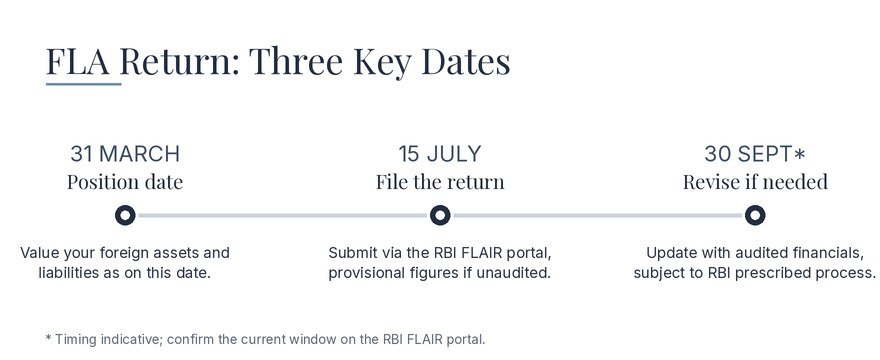
The FLA Return is generally required to be filed by July 15 each year, reporting the position as on the preceding March 31. The submission is made online through the RBI FLAIR portal, where the entity first registers, receives login credentials, and then completes the return.
Because the deadline falls before most audits are complete, the framework anticipates a two-step approach for entities whose financial statements are not yet finalised.
Provisional Filing and Revision
Where audited financial statements are not ready by July 15, entities are generally expected to file the FLA Return using provisional or unaudited figures by the due date, and then revise the return once the accounts are audited, subject to the RBI prescribed process. In practice the revised return is typically filed after finalisation of audited financials, often by the end of September, but the exact window and mechanics should be confirmed on the FLAIR portal for the relevant year.
The key discipline is to file something accurate and good-faith by July 15 rather than miss the deadline while waiting for the audit. A provisional filing followed by a timely revision is the expected route, not an exception.
Exit or Disinvestment During the Year
Exiting an investment during the year does not automatically remove the filing obligation. If an entity held outstanding FDI or ODI at the relevant reporting dates, it may still be required to report the historical position and reflect the subsequent disinvestment appropriately. Treating an exit as an automatic end to reporting is a frequent source of missed filings, so the year of exit deserves particular care rather than less.
GIFT City and IFSC Structures Need Special Attention
Investment structures involving GIFT City and other International Financial Services Centre (IFSC) units call for closer reading, because reporting responsibilities are split across two regulators. Recent RBI clarifications distinguish the obligations of IFSC entities from those of their Indian counterparties.
As a general framework, IFSC entities follow the instructions issued by the International Financial Services Centres Authority (IFSCA), while Indian resident entities that invest into, or receive investment from, IFSC entities continue to have RBI reporting obligations where applicable. In other words, being connected to an IFSC structure does not switch off your RBI reporting: an Indian resident entity on the other side of the transaction may still need to report under the FEMA framework. Given how these clarifications are evolving, cross-border structures touching GIFT City should be reviewed on their specific facts.
Consequences of Delayed or Non-Filing
Non-filing or delayed filing of the FLA Return is treated as a contravention under FEMA rather than a simple missed form. Contraventions can attract penalties under the FEMA penalty framework, and are commonly regularised through the RBI compounding process, where the entity applies to have the contravention compounded on payment of a compounding amount.
The precise exposure depends on the facts, the period of delay, and the amounts involved, and is determined under the applicable FEMA provisions in force at the time. Because the cost and effort of compounding usually far exceed the effort of filing on time, the practical takeaway is straightforward: treat July 15 as a fixed annual deadline and file, provisionally if necessary, rather than let a position go unreported. Confirm the current penalty and compounding position with a professional advisor for any specific case.
Practical Compliance Checklist
- Review outstanding FDI and ODI positions as on March 31, including historical holdings still on the books
- Validate shareholding, valuation, and financial information used in the return
- Identify related-party foreign balances correctly, including group and associate exposures
- Register on, or confirm access to, the RBI FLAIR portal well before the deadline
- File before July 15 through the FLAIR portal, using provisional figures if the audit is not complete
- Revise the return, if required, after finalisation of audited financials, within the prescribed window
- Give GIFT City and IFSC-linked structures a separate review to confirm who reports what
Frequently Asked Questions
Who must file the FLA Return?
Any Indian entity, whether a company, LLP, or other reporting entity, that has received FDI or made overseas investment and holds outstanding foreign assets or liabilities as on March 31, even if there was no fresh transaction during the year.
What is the due date?
Generally July 15 each year, reporting the position as on the preceding March 31, filed through the RBI FLAIR portal.
Do we file if there was no transaction during the year?
Yes, generally. The FLA Return is position-based. Outstanding FDI or ODI as on March 31 can trigger the filing even where no new investment took place.
What if the audit is not finished by July 15?
File using provisional or unaudited figures by July 15 and revise the return after the accounts are audited, subject to the RBI prescribed process.
How do GIFT City and IFSC structures affect reporting?
IFSC entities follow IFSCA instructions, while Indian resident entities on the other side of the transaction generally continue to have RBI reporting obligations where applicable. These structures should be reviewed on their specific facts.
Conclusion
The FLA Return is often viewed as a routine annual formality. In reality it is one of the RBI's most significant reporting mechanisms, capturing India's international investment position one entity at a time. Its logic is position-based, so the question is never only what you did this year, but what you still hold as on March 31.
If your company has foreign investors, overseas subsidiaries, or any cross-border investment structure, the right time to review your FEMA reporting obligations is before the deadline, not after it. Accuracy matters just as much as timely filing.
This article expands on a compliance note originally shared by our team on LinkedIn. View the original LinkedIn post.